Looking for work in New Zealand right now can feel like shouting into a void. You apply, you wait, and most of the time nothing comes back. That's not just you: the numbers say it's a harder market than it was a few years ago.
The good news is that there are more jobs being advertised than a year ago, and some of the best places to find them are ones most people skip. This guide covers what the 2026 job market looks like, where to look, why employers' own career sites deserve a place in your search, and how to apply so your application gets read.
Is it hard to get a job in NZ right now?
Honestly, yes. Stats NZ (opens in a new tab) put the unemployment rate at 5.6% in the June 2026 quarter, up from 5.4% in March. 1News reported (opens in a new tab) that's the highest in 11 years.
At the same time, job ads are recovering. The SEEK NZ Employment Report for August 2026 (opens in a new tab) found job ads were 9.7% higher than a year earlier. But applications per job ad also rose, even with more jobs to go around.
So there are more jobs than last year, and more people going for each one. That changes how you should search:
- Look wider. If you only search one job board, you only see the jobs advertised there.
- Apply better, not just more. When every ad gets a crowd, a CV written for that job stands out from a hundred generic ones.
Where to look for jobs in New Zealand
There's no single best job site in NZ. Most people find work through a mix of these:
- The big job boards. SEEK, Trade Me Jobs and LinkedIn carry a large share of advertised jobs, and they're worth checking. They're also where every other applicant is looking.
- Sector job boards. Teaching jobs go on the Education Gazette, and many health jobs go on Kiwi Health Jobs. If your field has its own board, use it.
- Recruitment agencies. Good for contract work, and for fields like IT, finance and the trades. The employer pays the agency, not you.
- Employers' own career sites. The careers page on an organisation's website, where it posts its own vacancies. More on these below.
- People you know. Former colleagues, lecturers, your sports club, your community. A quick message asking who's hiring costs nothing.
Tahatū Career Navigator (opens in a new tab), the government's careers service, lists employers' websites alongside job sites, social media and recruitment agencies. It also suggests picking out places you'd like to work and contacting them directly.
Why employers' own career sites are worth checking
Most job seekers never visit a company's careers page. They wait for the job to show up on a job board. But in New Zealand, an employer doesn't have to put a job anywhere else. Employment New Zealand (opens in a new tab) says you don't have to advertise a job unless it's a requirement, such as your own recruitment policy or the law.
Immigration New Zealand's advice (opens in a new tab) is direct about it: "The best approach is to check an organisation's website. You can find their contact details, as well as information about any jobs they may not be advertising anywhere else yet."
Some jobs live on the careers page for days before they reach a job board, and some never do. Others are also on the job boards, but applying on the employer's own site puts you straight into their system with no middleman.
There's some evidence it pays off, too. In the US, the hiring software company JobScore's 2026 benchmarks (opens in a new tab) found career sites brought in 13% of applicants but 27% of hires, while job boards brought in 61% of applicants and 43% of hires. That's American data from one company's customers, so take it as a pointer rather than a rule, but the direction is clear: people who apply through the careers site are hired at a higher rate.
What about "80% of jobs are never advertised"?
You'll see figures like "70% to 80% of jobs are never advertised" all over the internet. There's no good source for them in New Zealand. When someone asked the Ministry of Business, Innovation and Employment about the hidden job market under the Official Information Act, MBIE didn't have the information (opens in a new tab). Nobody here measures it.
What we do know is enough: employers don't have to advertise, the government tells job seekers to check employer websites, and some jobs on careers pages aren't on the job boards yet. You don't need a made-up statistic to see that it's worth looking.
The catch: there are hundreds of career sites
Checking one employer's careers page is easy. Checking every hospital, council, bank, retailer, engineering firm and government agency you'd work for, every few days, isn't. That's why most people don't do it.
That's what the SmartCVs job board is for. It collects jobs straight from employers' own career sites, twice a day, and puts them in one place. On 3 October 2026 it had close to 3,000 open roles in New Zealand, with more than 1,200 posted in the last week. You can browse it by region, like jobs in Auckland, Wellington and Canterbury, or by field, like IT jobs and engineering jobs.
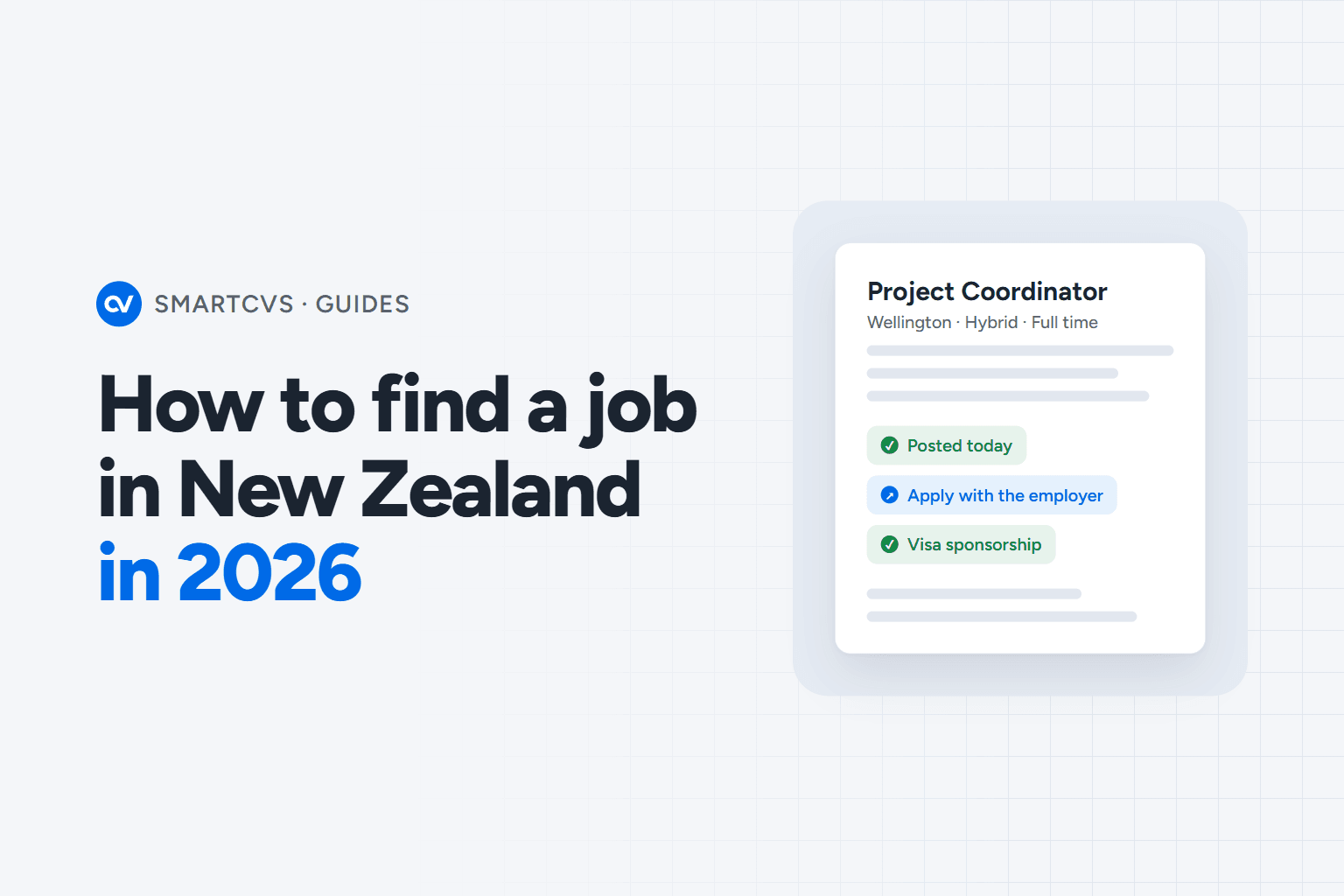
Each job shows what you need to decide quickly: the employer, the location, the pay when the employer shares it, whether it's onsite, hybrid or remote, the experience it asks for and its key requirements. You can filter by date posted, job type, work type, salary, experience, company size and visa sponsorship.
When you're ready, Apply takes you straight to the job on the employer's own site. There's no sign-up in the way, and your application goes to the employer, not to us. It's free to browse, and you don't need an account.
How to find visa sponsorship jobs in NZ
If you need a work visa, you're usually looking for an employer who can support an Accredited Employer Work Visa (opens in a new tab) (AEWV). Immigration New Zealand says it's for people with a job offer from an accredited employer of at least 30 hours a week, and it can last up to 5 years depending on the job.
Two things help:
- Check the employer. Immigration New Zealand has an accredited employer list (opens in a new tab) you can search by name or NZBN. It's updated daily, but some employers choose not to appear on it, so if one isn't listed, ask them.
- Filter for it. On the SmartCVs job board, the visa sponsorship filter shows jobs whose ads mention sponsoring a visa. Always read the ad itself, since what an employer offers can depend on the role.
Our guide for international candidates covers what New Zealand employers expect from an overseas applicant's CV.
Apply so your CV gets read
Finding the job is half the work. With more applications per ad, a CV sent out unchanged to twenty jobs tends to get twenty silences.
- Tailor your CV to each job. Tahatū says to tailor your CV (opens in a new tab) for each application, using keywords from the job ad. If the ad asks for "stakeholder engagement" and "Excel", say so in those words, and back it up with what you did.
- Write the cover letter. In New Zealand, Tahatū says a cover letter (opens in a new tab) goes with your CV when you apply. Keep it to one page and write it for this job.
- Follow the local format. No photo, no date of birth, two pages if you can. Our New Zealand CV format guide explains it, with sources.
- Apply soon. On the SmartCVs job board, the Date posted filter can show just the last 24 hours or the last 7 days. Some employers read applications as they arrive, so an early one can't hurt.
If you'd like a starting point, there are CV examples and cover letter examples for 50 New Zealand roles.
A simple weekly job search routine
A routine beats a burst of panic-applying on a Sunday night. Try this:
- Twice a week, check what's new. Open the job board for your field and region, set Date posted to the last week, and save anything that fits.
- Pick your best three to five. Read each ad properly. If you can show evidence for most of what it asks, it's worth applying.
- Tailor and apply. A tailored CV and cover letter for each, sent on the employer's own site.
- Track it. Write down where you applied and when, so you know when to follow up.
- Reach out to one person. A former colleague, a manager at a place you'd like to work, someone in the job you want. Ask a question, not for a job.
How SmartCVs helps
SmartCVs is built for the "tailor and apply" part, which is the part that takes the longest.
Find a job on the job board and choose Tailor my CV for this job. SmartCVs takes your profile, shows which of the ad's requirements your experience already answers, and writes a CV and cover letter for that job, in its words. It won't invent experience you don't have: a gap is shown as a gap. Save keeps the job in your job tracker, so you can follow it from To apply to Offer. And the Career Coach can look through the board for jobs that fit your profile and tell you why.
The free plan gives you 3 job scans a week, each with a tailored CV and cover letter. Not sure how your CV reads now? Start with the free CV check.
Frequently asked questions
What are the best job sites in NZ?
There isn't one best site. SEEK, Trade Me Jobs and LinkedIn carry many advertised jobs, sector boards like the Education Gazette cover their fields, and employers' own career sites carry jobs that may not be on the job boards yet. The SmartCVs job board brings jobs from employers' career sites into one place.
Is it better to apply on the company website or a job board?
If a job is on both, applying on the employer's own site is a good default. It goes straight into their hiring system, and you see the ad exactly as the employer wrote it, sometimes with more detail than the job board version.
How can I find jobs that aren't advertised on SEEK?
Check employers' own career sites, either one by one or through the SmartCVs job board, which collects them twice a day. Talk to people in your field, and contact employers you'd like to work for directly. Immigration New Zealand calls approaching employers directly "an accepted and often successful approach".
Do New Zealand employers expect a cover letter?
Usually, yes. The government's careers service says a cover letter goes with your CV when you apply. Keep it to one page and write it for the job.
Can I find jobs with visa sponsorship in New Zealand?
Yes. Look for accredited employers who can support an Accredited Employer Work Visa, check them on Immigration New Zealand's accredited employer list, and use the visa sponsorship filter on the SmartCVs job board.